Observing the Moon with a Modified Satellite Dish
The Moon is one of the most prominent objects in the night sky — not only in visible light but also in the radio domain. This property makes it a rewarding target for amateur radio astronomy, since its radiation characteristics can be measured with simple equipment. A TV satellite dish of one metre in diameter is sufficient to address a range of interesting questions experimentally, including measurement of the surface temperature, investigation of the thermal properties of the regolith, and the influence of Earth’s atmosphere on radio waves.
The thermal radiation of the Moon is not a reflection of sunlight as observed in the optical domain, but so-called blackbody radiation. It originates from the heat stored in the lunar soil, which warms under solar irradiation during the day and cools again at night. This thermal radiation falls in the infrared and radio ranges. Its intensity and spectral peak depend directly on the surface temperature. The peak lies at temperatures around freezing point in the mid-infrared, but even at frequencies in the range of 12 to 22 gigahertz it remains strong enough to be detected with amateur equipment.
For the observations, a satellite dish with a diameter of one metre was used. The mount was a Celestron AVX equatorial mount, enabling precise tracking along the Moon’s apparent path across the sky. The receiving units — known as LNBs — came from professional satellite technology: in the Ku-band (12.25 to 12.75 GHz) a NORSAT 1000XB was used, and in the Ka-band (21.2 to 22.2 GHz) a NORSAT 9000LDF. Both were powered via a bias tee.
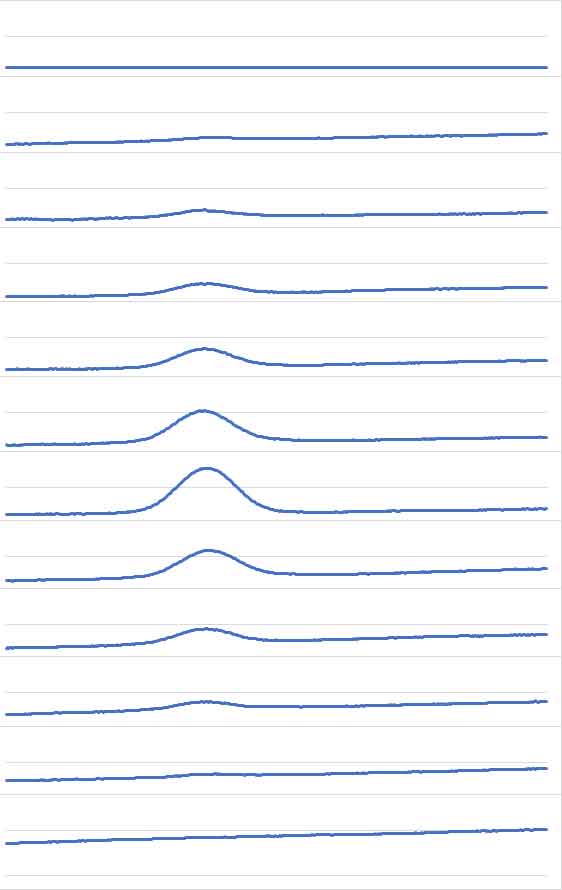
The following image was recorded with our new ASTW receiver — a broadband detector based on the AD8362, an ADS1118 ADC, and an Arduino — for which we published a build guide in a previous article. The signal of the Moon was recorded in the 22 GHz band. Not only is the Moon’s signal clearly visible. It is also apparent that the sky towards the west becomes “brighter”, i.e. shows more background noise — an indication that at 22 GHz atmospheric factors are increasingly influencing observations.

To produce this image, 12 scans were performed above, along, and below the Moon’s apparent path. The recorded data were exported to an Excel spreadsheet, consolidated in a single table, and visualised using the Conditional Formatting function, converting the raw signal values into a recognisable image. After the image was created, the transitions between individual “pixels” were smoothed with a Gaussian blur filter to improve visual clarity.
In a second step we wanted to learn more about the Moon’s properties. To improve the comparability of measurements, we switched to an SDRplay RSP1B as receiver, recording signals using SDR-UNO software together with a plugin called “SDRUnoPluginUDS” into Radio-SkyPipe. The bandwidth was approximately 200 kHz. The transit curves with the SDRplay are considerably noisier than those from the AD8362 due to the narrower bandwidth, but comparability between multiple measurements is significantly easier with this method for various reasons.
Before the actual observations began, the system was calibrated using the so-called hot-cold method: the radio telescope was alternately pointed at the cold sky (approximately 2.7 Kelvin) and at an object of known temperature — in this case a building wall (approximately 273 Kelvin). From the ratio of the two readings the system temperature can be determined, which is a measure of the total noise of the receiving system. For the 12 GHz system this yielded approximately 147 Kelvin; for the 22 GHz system approximately 185 Kelvin.
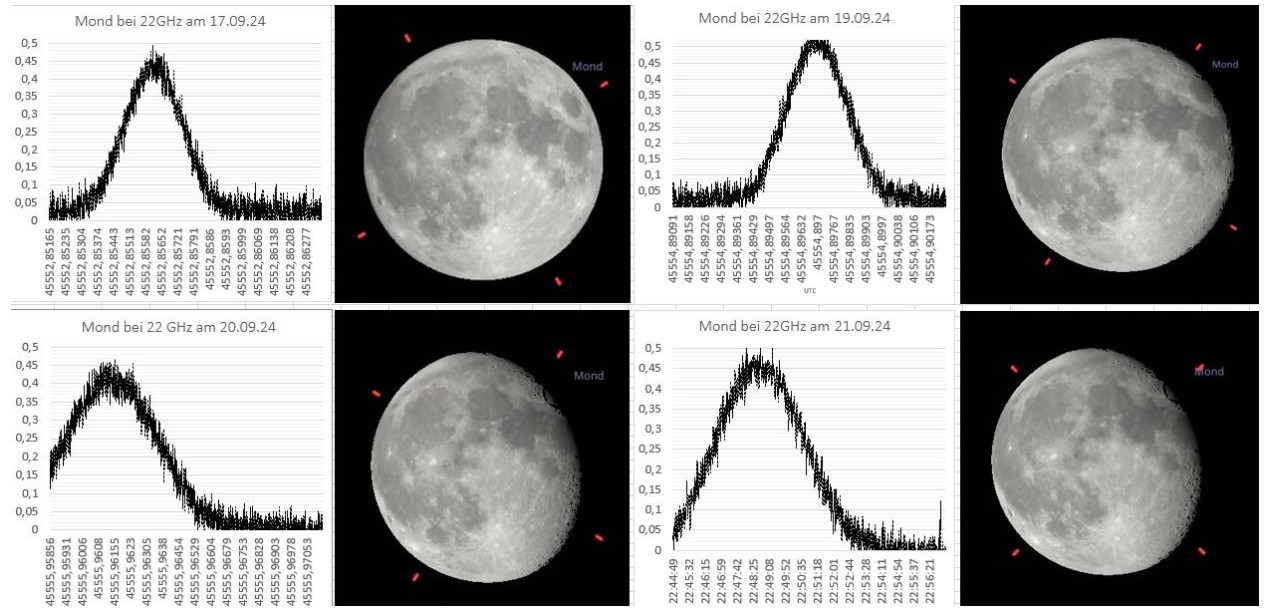
The actual observations took place over several days in September 2024 on the grounds of Archenhold Observatory in Berlin. In addition to the full Moon on 17 September, measurements were also taken on subsequent days through to 21 September. The 19th of September was particularly well-suited, as transit observations could be carried out in both the Ku- and Ka-bands on that day. In a transit observation the antenna is fixed on a point while the Moon drifts through the antenna beam. From the characteristic signal rise both the beamwidth and the radiation temperature of the source can be determined.
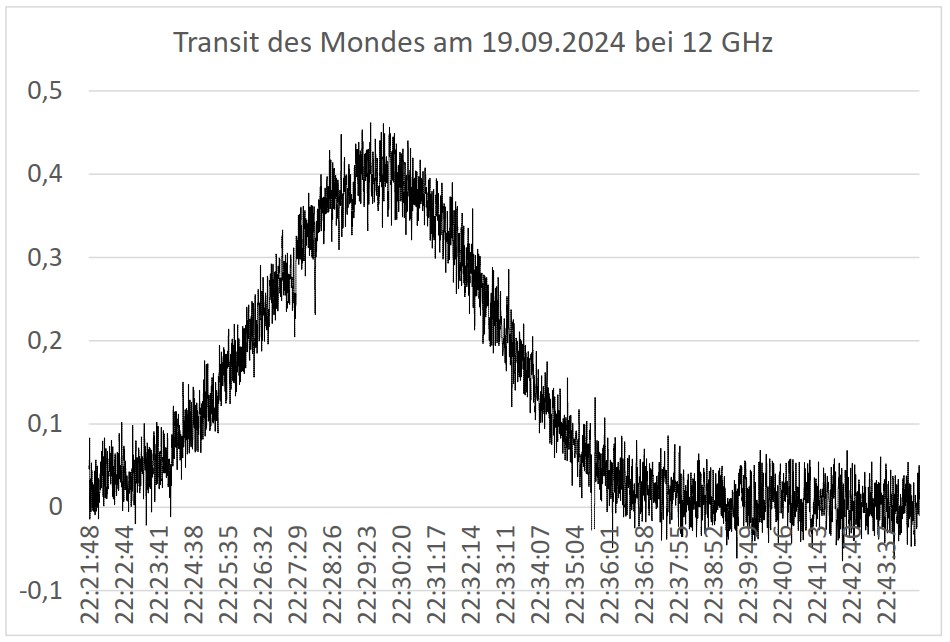
In the Ku-band the beamwidth was approximately 1.72 degrees. The measured signal rise during the Moon’s transit on 19 September 2024 was 0.45 decibels. Taking into account the system temperature and the fraction of the antenna beam actually covered by the Moon, this yields an effective radiation temperature of the Moon of approximately 193 Kelvin, corresponding to about −80 degrees Celsius. In the Ka-band the beam was narrower at 1.25 degrees and the signal rise larger at 0.55 decibels. Nevertheless, the calculations yielded a lower lunar temperature of approximately 153 Kelvin, or around −120 degrees Celsius.
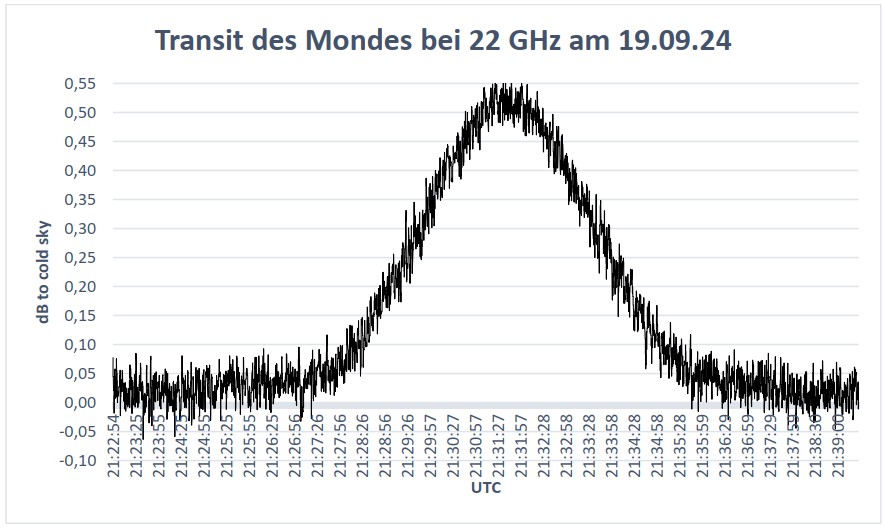
This discrepancy can possibly be explained by atmospheric attenuation. Water vapour in Earth’s atmosphere plays a particularly significant role at 22 gigahertz, where a strong absorption line of the water molecule exists that attenuates part of the radiation arriving from the Moon. Since the Ka-band measurement was taken at a lower elevation — meaning the beam had to pass through a longer column of air — greater attenuation is expected. The difference of approximately 40 Kelvin corresponds to an attenuation of about 0.13 decibels, which agrees well with values for atmospheric attenuation at this frequency reported in the literature.
A notable effect was observed when comparing results across several days. While the highest signal rise in the Ka-band was not measured on the day of the full Moon but two days later, the radiation subsequently declined only slowly. This time delay can be explained by the thermal inertia of the regolith. The lunar surface does not release absorbed heat immediately. The deeper the layer sampled by radio waves, the more slowly it responds to changes in solar irradiation. At lower frequencies the radiation penetrates deeper into the ground, so the measured temperature fluctuates less strongly between day and night.
A control measurement taken during a waxing half-moon in January 2025 confirmed this observation. With a comparable configuration, a significantly lower effective lunar temperature was obtained, as at that phase neither the night nor the day side of the Moon had yet reached their extreme temperatures. This again made clear how strongly the combination of lunar phase, frequency, atmospheric conditions, and elevation can influence measurement results.
The Moon is therefore far from a dull subject for radio astronomy. It is an excellent object for testing one’s radio telescope, determining its sensitivity and resolution, and simultaneously observing fundamental astronomical phenomena. This observing campaign shows that with simple equipment and a degree of patience, both physical and atmospheric effects can be traced — and that the Moon remains a fascinating subject of investigation even for amateur astronomers.