Observing Cygnus A – A First Attempt
One of our projects last year was to observe the radio galaxy Cygnus A. Until then we had only detected two continuum sources — the Sun and the Moon — so Cygnus A was new territory for us. We used our 180 cm C-band dish with a loop feed for 1420 MHz. The LNA was a Sawbird+ H1, and the receiver a Nooelec NESDR SMArTee. Data recording was handled by ezCOL from the ezRA suite; processing and integration were done in MS Excel. The observations were carried out at Archenhold Observatory. We pointed the antenna at a right ascension of 41° and recorded a total of 19 transits at a frequency of 1425 MHz with a bandwidth of 2 MHz. In the data we could indeed observe a rise in signal level during the expected time window:
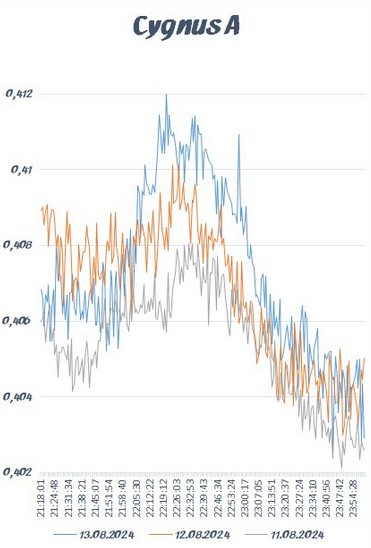
The transit curves were offset by 4 minutes each day — clear evidence that we were dealing with a signal of extraterrestrial origin. In the individual transit curves the radio signal was only faintly visible, so we stacked the curves and computed the average. With each additional integrated curve the signal became more distinct. The result was a summed curve in which Cygnus A and Cygnus X are clearly distinguishable from one another:
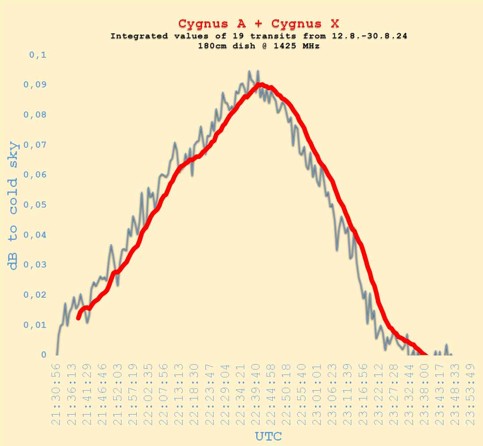
The small bump on the left comes from Cygnus A; the main peak represents the combined emission of both sources. Our antenna has a beamwidth of approximately 9° at 1425 MHz. Although Cygnus A and X are only about 4° apart, they can still be identified as separate sources. The reason: Cygnus X is not a point source but an extended star-forming region spanning roughly 10–12°. Although the radio galaxy Cygnus A has a significantly higher radio brightness, the star-forming region Cygnus X contributes substantially to the summed curve thanks to its much larger angular extent. Cygnus X is invisible at optical wavelengths — the true structure of this vast star-forming region only reveals itself through a radio telescope, or an infrared telescope, though the latter can only be operated in space due to atmospheric absorption. Below is a radio image of the region containing Cygnus A and Cygnus X. It is taken from the all-sky survey at 408 MHz and can be downloaded from the SkyView website at https://skyview.gsfc.nasa.gov/