On the occasion of the lunar eclipse on 18 September 2024, we observed the full Moon with our mobile 1-metre radio telescope.
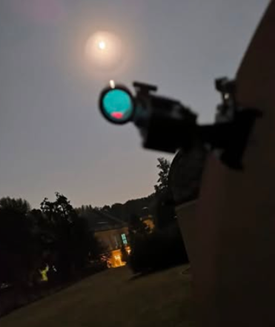
Two different Norsat LNBs were used: the 12 GHz LNB produced no usable results due to interference from geostationary satellites. With the Norsat 9000 LNB for 22 GHz, the Moon was clearly detectable, as this frequency is unaffected by broadcast satellites. The narrower beamwidth of the antenna at this frequency also allows better focus on the Moon as a point source.
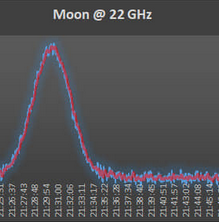
The radio emission at 22 GHz originates from the thermal radiation of the lunar surface rather than reflected sunlight, which makes detection challenging. The successful test demonstrates that our system is sensitive enough to enable future observations of masers in star-forming regions at 22 GHz. Unfortunately, clouds moved in around midnight, preventing continuation of the eclipse observation, which was only a partial eclipse in any case. Since the temperature of the lunar surface barely drops while in Earth’s shadow, it is also not possible to observe a lunar eclipse with an amateur-class radio telescope.
Back to top