The image below shows a scan of the entire sky from the horizon to the zenith in the 1420 MHz frequency range.
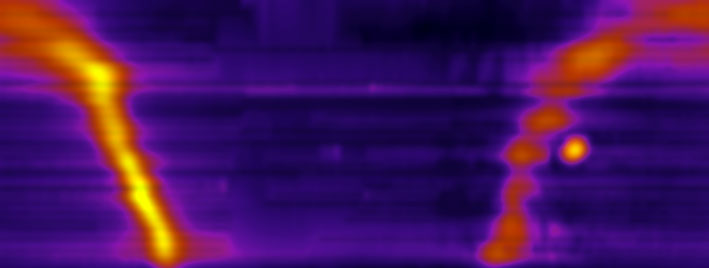
As part of an HI sky survey, 33 drift scans were carried out in steps of 3 degrees. The setup consisted of a 180 cm C-band satellite dish from China on a manual mount, a loop feed for 1420 MHz, a Nooelec Sawbird H1 LNA, and a Nooelec NESDR SMArTee SDR. Data recording and processing was handled by the ezRA (EasyRadioAstronomy) software. The image was captured at Archenhold Observatory under urban conditions with significant electromagnetic interference. An additional problem was that wind moved the unsteady mount, occasionally causing the antenna to shift its azimuth involuntarily. In short: conditions were poor. ezRA aggressively filters out continuum sources such as the Sun in order to bring out the faint signals of the Milky Way. The continuum sources are, however, present in the raw data. Fainter continuum sources such as Cassiopeia A, Cygnus A, etc. lie in the plane of the Milky Way and are masked by the galactic hydrogen emission at 1420 MHz.
The Sun’s signal is present in the raw data. We applied a trick and reduced the bandwidth of the solar signal to 40 kHz, so that ezRA no longer filters it out. This made the Sun visible in the final processed image. The Sun shines so brightly in the radio domain — ten times brighter than the brightest regions of the Milky Way — that it would otherwise have drowned out the galactic emission entirely. By reducing the solar signal bandwidth to 40 kHz, it appears dimmer and no longer overwhelms the Milky Way.
On the right-hand side the Sun can be seen alongside the Milky Way band. That section of the Milky Way band is only visible during summer daytime and appears less bright, as it represents the outer regions of the Galaxy in the direction opposite to the galactic centre.
Back to top