Observing the Water Maser in the Orion KL Nebula with a 1-Metre Radio Telescope
In January 2025, Berlin had exceptionally clear skies for that time of year, with the Moon clearly visible — perfect for using a red-dot finder to precisely point our 1-metre radio telescope at specific sky positions and to polar-align the mount for accurate tracking. It was the ideal moment to attempt something we had never tried before: observing an astrophysical maser in the constellation Orion!
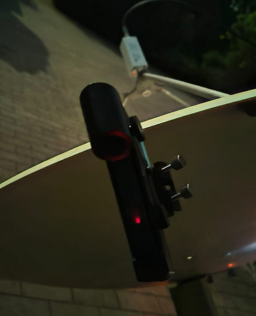
Orion KL is a star-forming region within the Orion Nebula that can only be observed in the infrared and radio domains, as dust clouds prevent it from being seen in optical light. What makes it special: this star-forming region naturally produces maser emission — extremely concentrated, bright radiation, much like a laser but in the microwave range. An important emission line is that of water at 22 GHz, and Orion KL radiates strongly in this spectral band.
On our first attempt we saw… absolutely nothing. We had tuned the receiver to the wrong frequency range — lesson learned. But on the second day things got much more exciting! We pointed the parabolic antenna precisely at Orion KL and tracked the Orion Nebula using the AVX mount’s drive. We collected data for one hour, continuously monitoring the position with the red-dot finder to prevent Orion KL from drifting out of the antenna beam. Since the half-power beamwidth (HPBW) of a 1-metre antenna at 22 GHz is only 1 degree, there is little margin for error.
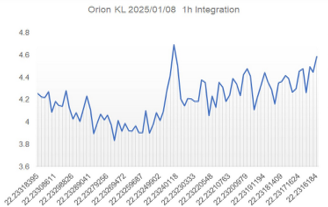
We also took a 20-minute offset measurement approximately 5 degrees above Orion to account for system noise. This offset was subtracted from the primary data in Excel to smooth out SDR-induced spectral distortions. The baseline noise was not perfectly uniform, but the most significant irregularities were removed.
And there it was… a narrow, faint line at around 22.2324 GHz!
To verify that this was not merely an artefact, we created a waterfall diagram by grouping sets of 3,000 measurements (6 minutes) into rows using Excel’s conditional formatting. The result? A continuous line running through the entire observation.
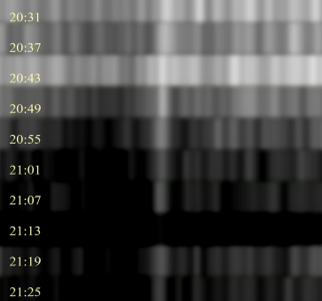
The line appears to drift slightly towards higher frequencies — probably due to local oscillator instability, or possibly due to Earth’s rotation affecting the Doppler shift.
Setup: 1-metre satellite dish on a Celestron AVX mount, Norsat 9000LDF LNB for 22 GHz (Ka-band), SDRplay and SDR Console for frequency tuning, Data acquisition with Radio Sky Spectrograph, Exported and analysed in Excel
Weather and conditions permitting, we intend to repeat the measurement to verify and confirm the result.
More information and a stunning JWST image of the Orion KL Nebula: https://en.wikipedia.org/wiki/Orion_KL
Back to top