The Sun at Three Wavelengths
Software Defined Radios (SDRs) open up possibilities in amateur radio astronomy that would have been unimaginable just a few years ago. SDRs are available from as little as €30, as in the case of the Nooelec Smart SDR. The first radio telescope we built some time ago from an old 1-metre satellite dish is fully mobile and mounted on a Celestron AVX mount. What makes it special is the ability to install different receiving feeds at the focal point and to track objects. Until recently we had feeds for 12 GHz (Ku-band) and 1420 MHz (L-band). We later purchased an additional LNB for 22 GHz (Ka-band) from Norsat. To use it with the dish we had to fabricate a custom feedhorn ourselves. We designed it in a CAD program and had it machined from aluminium at a local metal workshop. In summer 2024 we were able to observe the Sun with it for the first time — and it worked! The images show the 1-metre radio telescope with the three different feeds and the results of a drift scan of the Sun.
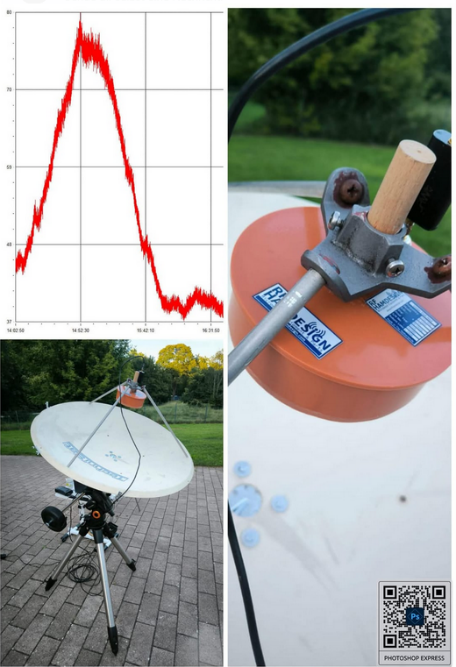
At 1420 MHz (loop feed with Sawbird H1) the time between the half-power points is approximately 60 minutes for the 1-metre dish. In mid-August the Sun was at a declination of 13°, giving a correction factor of cos(13°) = 0.97. The half-power beamwidth is therefore 1 × 15 × 0.97 = 14.55 degrees.
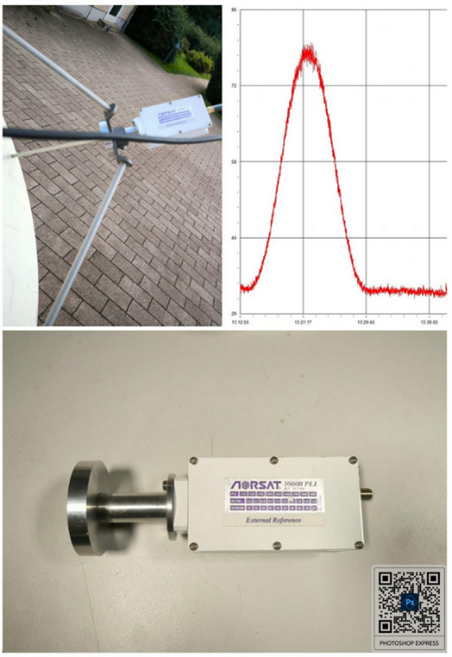
At 12 GHz the transit time is approximately 8 minutes, yielding a beamwidth of 1.9 degrees.
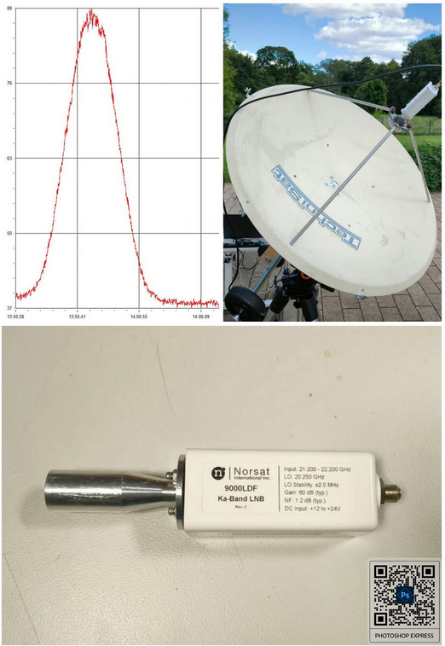
At 22 GHz the transit time was approximately 5 minutes, giving a beamwidth of about 1.2 degrees.
It is clearly evident that the beamwidth depends on the observing frequency for a given dish aperture: the higher the frequency (i.e. the shorter the wavelength), the narrower the beam and the better the angular resolution of the radio telescope. While at higher frequencies (11 and 22 GHz) the Sun’s thermal emission dominates, a significant fraction of its radio emission at 1420 MHz is non-thermal in origin, produced by electrons spiralling through strong magnetic fields in the solar atmosphere.
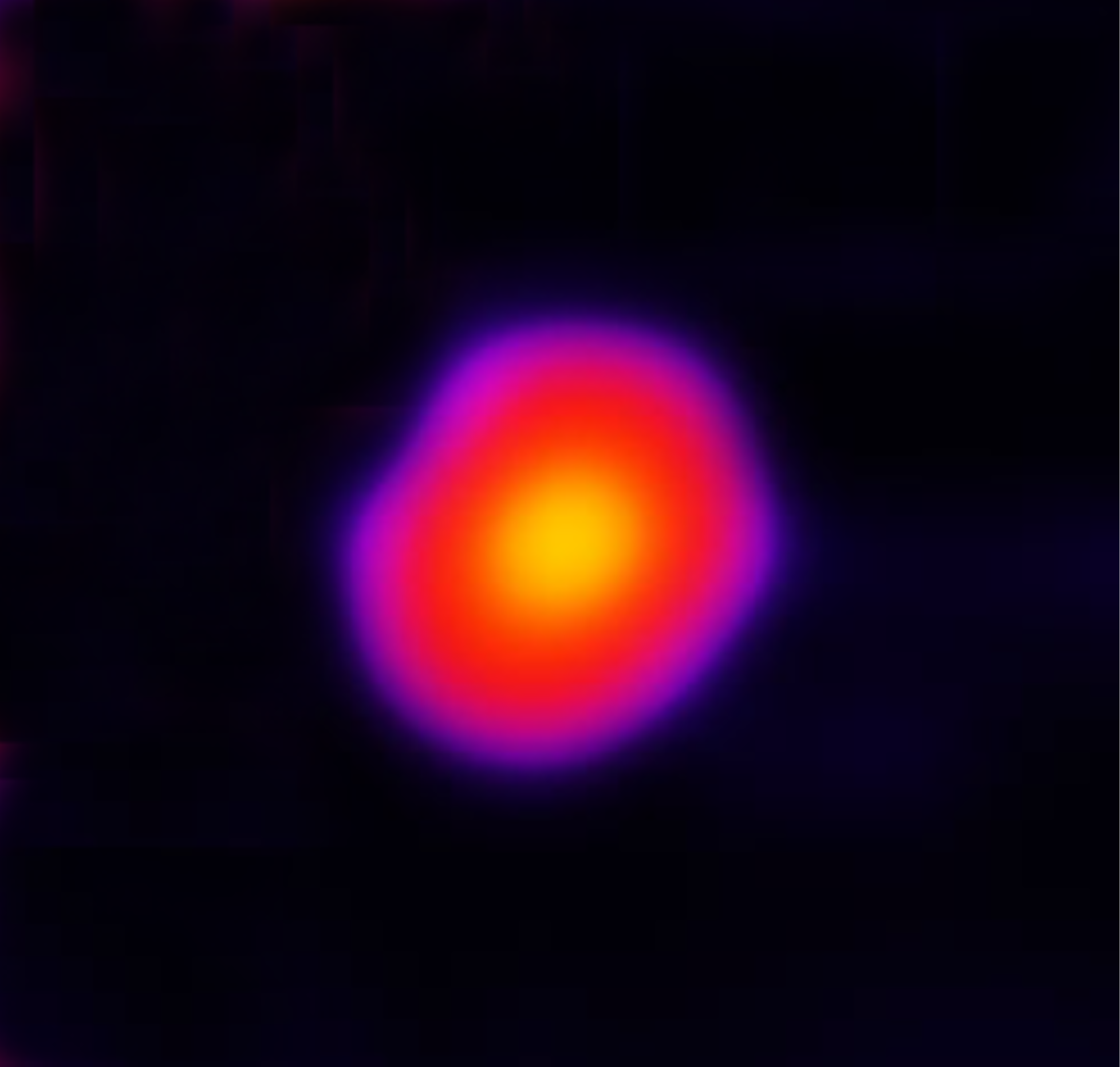
This image shows a scan of the Sun at 1420 MHz, obtained with the same receiving equipment during a sky survey to map neutral hydrogen in the Galaxy.
Back to top