Observing the Sun with a Simple SAT Finder
The Sun is not only the brightest object in the sky in visible light, but also the strongest natural source of radiation in the radio domain. At higher frequencies, the Sun’s thermal emission dominates, while at lower frequencies synchrotron radiation prevails, generated by electrons moving through strong magnetic fields.
What is thermal radiation?
Thermal radiation is heat radiation emitted by every body with a temperature above 0 Kelvin. The intensity and the peak wavelength of the radiation depend on temperature. The Sun has a surface temperature of approximately 6000 K, which places its radiation maximum in the visible range. Nevertheless, it also emits thermal radiation in the infrared and radio domains, albeit at lower intensity.
A straightforward way to observe the Sun’s thermal radiation yourself is to use a standard satellite dish with an off-the-shelf LNB (frequency range 11–12 GHz). These can be acquired cheaply second-hand or sometimes even obtained for free. We used a prime-focus TV satellite dish from Technisat with a diameter of 1 metre, a standard Ku-band LNB (Invacom flange LNB SNF 031), and a SAT finder. The LNB is normally powered through the TV receiver via the coaxial cable (12–18 V). This power supply must now be injected into the coaxial cable independently. For the first experiment it was convenient that the SAT finder came with its own battery compartment (see image). Alternatively, any 12-volt DC source (e.g. a car battery, lead-acid accumulator, a powerbank with a 12 V output, or a mains power supply) can be used, injecting the power into the coaxial cable via a bias tee. The LNB is mounted on the satellite dish and connected to the SAT finder and the power source via coaxial cable. When the dish is pointed at the Sun or another object, the SAT finder displays a signal strength reading. To confirm that the Sun rather than a geostationary satellite is being detected, the movement of the signal can be monitored — the Sun drifts through the antenna’s field of view and the signal decreases over time.
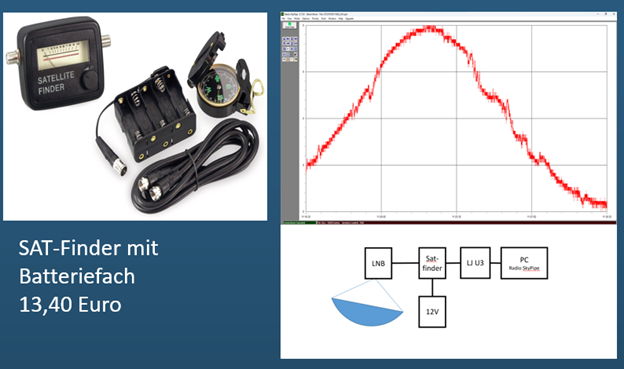
To record the data, the output signal of the SAT finder can be digitised using an analogue-to-digital converter (we initially used a LabJack U3) and displayed on a PC. The free software Radio SkyPipe enables graphical analysis of the measurements. Using a so-called drift scan, the movement of the Sun through the antenna’s field of view can be observed, producing a Gaussian bell curve whose half-power beamwidth determines the angular resolution of the radio telescope. In our experiment with a 1-metre dish, a resolution of approximately 1.7° was obtained.
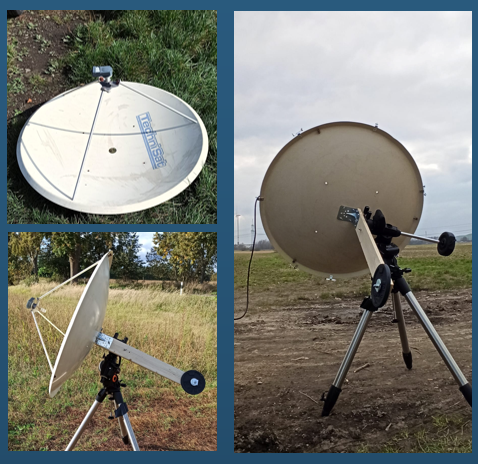
This simple experiment is an excellent introduction to radio astronomy. Using a standard satellite dish and a SAT finder, the thermal radiation of the Sun can be readily detected and measured. At the same time, a transit measurement of the Sun — via the half-power beamwidth — allows the antenna’s beam pattern and angular resolution to be determined.