Observing the Moon with the Logarithmic Detector AD8313
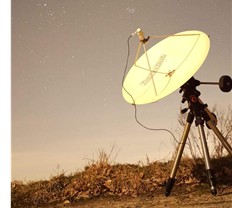
On 28 January 2024, shortly after midnight (23:06 UTC), we succeeded in recording the waning Moon at approximately 11 GHz from a field outside Berlin, using a 1-metre satellite dish, the Invacom LNB, a logarithmic detector (AD8313) connected to an analog-to-digital converter (LabJack U3) and a PC running Radio Sky Pipe. Several transit measurements were carried out that night, and the Moon was clearly identifiable in every one.
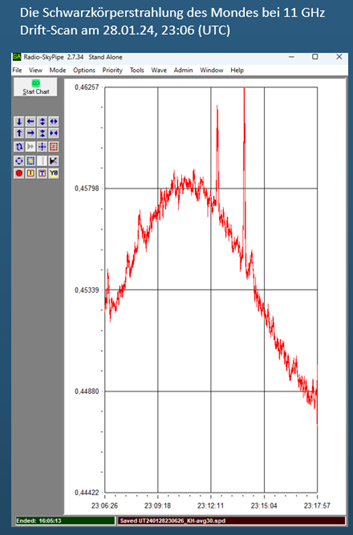
The diagram shows a parabolic curve representing the radio emission of the Moon at approximately 11 GHz. The Moon drifted into the field of view of my antenna, causing the signal to rise to a maximum, then drifted back out again. The Moon’s radio emission at 11 GHz is thermal radiation — it does not arise from the reflection of sunlight as in the optical domain, but from the thermal glow of the warm lunar surface. Although this radiation is very weak and the result demonstrates the high sensitivity of the system, the Moon is a relatively straightforward object at 11 GHz. Even with a small satellite dish, the Moon should be detectable without difficulty, provided a good LNB and a sensitive receiver are used.
One of the characteristics of the logarithmic detector is its very wide bandwidth. For continuum sources such as the Moon, this means that a larger amount of radiation is measured, making it possible to detect potentially weaker signals. On the other hand, the wide bandwidth also means that a large number of interference sources are picked up. On the evening in question, strong interference occurred regularly during every lunar measurement. The initial suspicion that it was caused by unwanted emissions from a mobile phone fed in via the cables proved to be incorrect — the interference persisted even when the phone was switched off. Could it have been signals from radio amateurs using the Moon as a communication relay (EME)? Or interference from satellites (the Starlink constellation also transmits in the 11 GHz band)? Or environmental interference? But why did it occur precisely whenever the Moon passed through the antenna’s field of view? No answer could be found. The logarithmic detector does not allow filtering by individual frequencies, which makes analysis difficult. To analyse or suppress such interference, one would need either analogue narrow-band filters or a software-defined radio (SDR) as the receiver, enabling digital signal filtering.