Using a Logarithmic Detector for Radio Astronomy
Instead of a SAT finder, a logarithmic detector can also be used to detect cosmic radio radiation. Such a detector produces a much more uniform signal than a SAT finder and is therefore also suitable for detecting weaker objects than the Sun, such as the Moon. Logarithmic detectors are currently available as thumb-sized boards at very low cost on the internet. What do these log detectors do? They convert a high-frequency AC input signal into a DC signal whose magnitude depends on the strength of the RF signal, i.e. its amplitude. The special feature of the AD8317 is that the output DC voltage does not increase linearly with rising signal strength, but instead decreases on a logarithmic scale. The output voltage typically ranges between 2 volts for a weak or absent signal and slightly above 0 volts for a very strong signal. The exact figures vary by device (the AD8317 ranges between 0.5 and 1.5 V) and can in some cases be adjusted. More detailed information can be found in the datasheets available online.
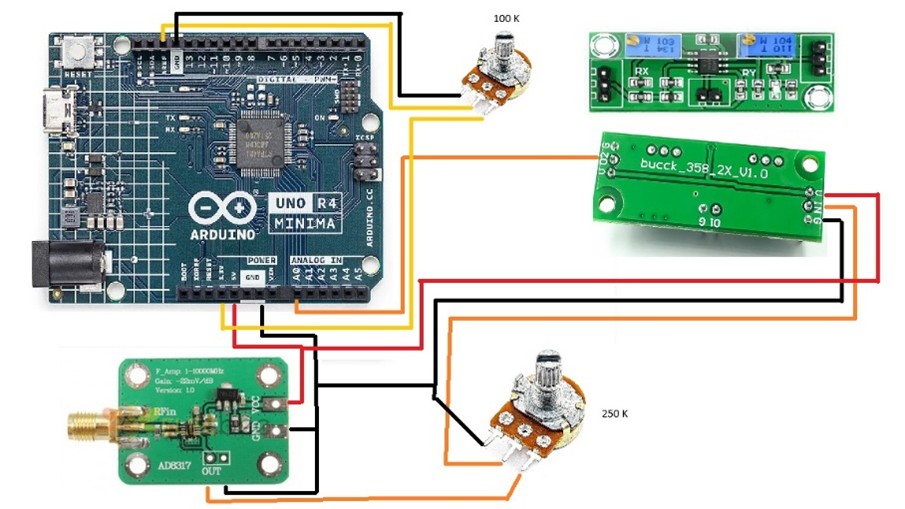
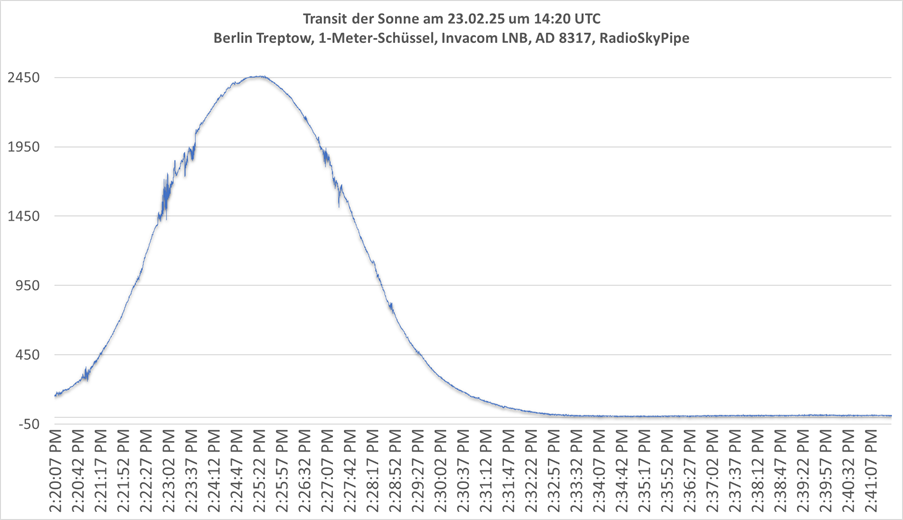
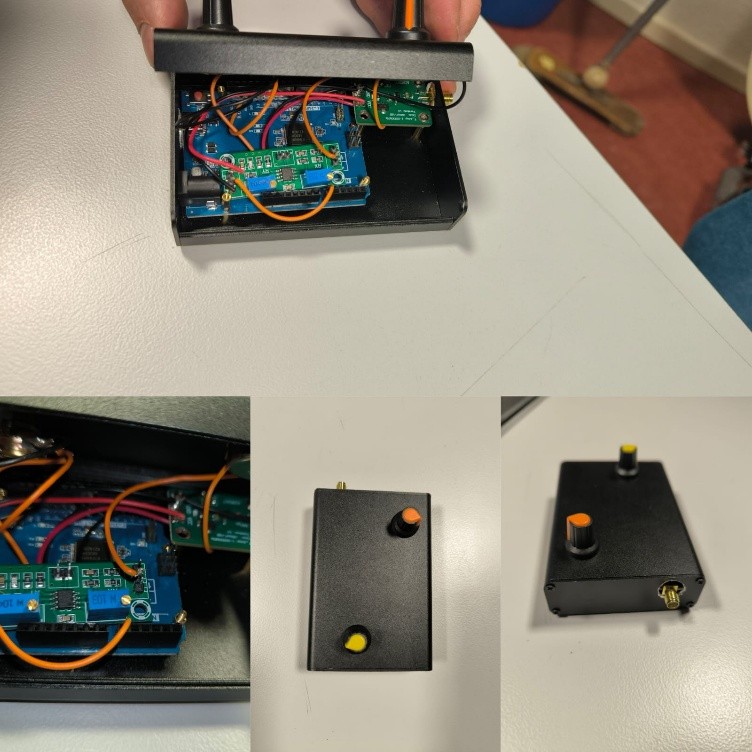
The simplest way to use the detector is to connect it directly to an analog-to-digital converter. We have successfully tested both the AD8313 and its successor model AD8317 with a LabJack U3 and an Arduino. To smooth the signal and adapt the sampling range of the ADC, an operational amplifier can be inserted between the logarithmic detector and the analog-to-digital converter. Shown here as an example are a schematic with an AD8317 log detector, an LM358 op-amp, and an Arduino R4, as well as the result of a solar transit on 23 Feb 2025 at 14:20 UTC in Berlin-Treptow (using the 1-metre dish, the Invacom LNB, the AD8317, and RadioSkyPipe as recording software).